Tuesday, May 6, 2014

Fingers Do the Walking on Teacher Appreciation Day

Tonight I had the most amazing experience.  For an hour, I got to walk in the shoes of my students by emulating their social media habit.

What?

Well, let's try it another way.

7:15
My computer froze, and upon reboot, my personal firewall locked access to Twitter.  I had 10 minutes until I was to help moderate a Twitter chat on what #teachingis (in honor of Teacher Appreciation Week).  My efforts to unlock the firewall failed.

7:28
I text my partner-in-crime to tell her that I was having internet issues.

7:30
I see a message pop up on Google Hangouts, asking from another co-leader, very nicely,  what the hold up was.

7:32
I open my Twitter app on my phone, and blindly introduce myself to the chat, tagging the chat with our #hashtag.

7:34
My computer unlocks enough to allow me to open my Google Chat script of questions and I hand-type the first question on my cell phone app.   The app also has a search feature that allows me to reply to questions.

7:44
I realize that each time I have a new question, my search window disappears.  And so more multitasking ensures.  A few spelling errors as well.

But the tweets fly, fast and furious.

8:05 We are all having a great time, and new people join our chat.
Welcoming them back knocks me out of the saved topic chat on my phone.

**EPIPHANY**

In the middle of the chat, I realize that this is how my students do most of their typing and communicating.   Most of them can knock a paper out on their phones as easily as I can type on a traditional keyboard.   I was raised on Smith and Wesson, they are part of the Samsung Galaxy or Apple-verse.  It appears to work well enough for then.

8:07  Back to the chat, and ideas are flying.  Humor and a surge of information moves the conversation and splits it several ways.

8:09 #thankateacher crosses over to #teachingis, which is a great fusion.  #thankateacher reflects the impact of the profession and #teachingis crosses over to visioning new ways to leverage the complex work that is being done.

8:30  The chat is almost done.   Everyone one looks at what we have accomplished.   I realize that a Storify is going to need to be pulled from the tweets, but I will do that in the morning.

With my computer.  Not a smart phone app.   At least for now.

And I am left with a nagging question.  What happens when we let the user decide the technology?  Perhaps what I see as a concession (yes, you can use the phone) is really a necessity (I can do it faster with my phone)

For me, I have fingers that are unaccustomed to rapid-fire texting.   At the end of the hour, my fingers felt stiff.  For others, that feeling of exhilaration and synergy may flow better from a phone than a keyboard.

But the great thing is that both of us, whoever we are, are right.  That's part of why #teachingis complex, rewarding, and worth pursuing.

photo credit: Johan Larsson via photopin cc


Tuesday, March 11, 2014

News Flash! Use your Teacher Skills

In the last three days, I have been reminded of a crucial thought.

I don't have to know everything.   What a great and freeing piece that is!  

I might break into Handel's chorus, but it's Lent, so I won't.


Case 1:  A close family friend is struggling with physics and has an upcoming test.   "I'm going to Kahn Academy, but I just don't get what they are saying.  Help!"

Don't you just hate it when that happens? The problem: this student lives 160 miles away, so coming over for a tutoring session was not a possibility.  He had gone to every physics class and study session and it just did not make sense.  The homework examples he had didn't match the samples from past tests.

What do you do when a kid doesn't understand a concept?
Good question.  That's why we need  teachers to reteach, differentiate, personalize.  And that is what I could offer.

First, I located some Paul Hewitt video clips.  Hands-down, when a student doesn't understand physics, it is because it lacks relevance to their personal experience.  Comics, xkcd discussions, targeted discussions all can help, but it will look different for different individuals

Second, I skyped with this student in 15 minute intervals over four days, answering specific questions.  She even identified a problem on an archived test that was missing a variable (and was later thrown out).  This is one of the best teaching moments--working to uncover misconceptions and then making a difference with some small detail that makes the light bulbs come on.

photo credit: zetson via photopin cc

Case 2:  My class is working on trusses in principles of engineering, a Project Lead The Way.   I can do trusses myself, but presenting on them makes me nervous.  I had already flipped the powerpoint, so students had it as a reference, and we had worked through the worksheet, which was confusing to them.

Time for a new resource.  Again, it is not possible to know everything.

Admitting that led me to the web, where I found a fabulous resource on youtube.  I'm much more likely to use youtube videos than professional production, mostly because the teachers who do make them are well-organized and the pedagogy for doing things seems more in line with my beliefs of how a student can learn.  This, for example, had the students working along with the teacher to do a problem..  Now, I did not require students to do work with this video.  They could use the worksheet, or keep working with the powerpoint.  It was a matter of choice....their choice.


Teacher skills:  flexibility, adaptability, working with others, respecting students, honoring the potential of all students to learn, making sure there is more than ONE right way, and understanding where to find resources that can help.

Fountain of all knowledge? Omnipotent?  Not even worth worrying about..

Sunday, January 26, 2014

Hey, Outliers, Leave My Kids Alone


I was really frustrated to read about the 'Battle Over the Science Standards' in the Des Moines Register today.  Just as annoying was the fact that KWWL  and KCRG picked up the AP as a debate for local control.  I smelled something that didn't ring true.  A simple Google vanity search and 10 seconds later, I had my answer.  Jill Jennings, the 'concerned parent' in the Register article, was a member of the task force that approved the NGSS standards; she also seems to be the outlier that doesn't believe in science or the science standards.  She said so, pretty clearly, back last September on one of Shane Vander Hart's conservative blog sites, when she paid homage to ignorance about climate change and advocated for Intelligent Design over evolution  in the classroom. Another home school parent is also quoted in the article.  This poorly-fabricated debate is an attempt to the sabotage the science standards by a very vocal minority.

If a small minority is unhappy with the NGSS, or the Iowa Core, or health class mandates, it is already possible for them to homeschool their children as a citizen of Iowa.  In fact, the people who have been part of the Iowa NICHE scored record victories in the legislature last year.  They can now homeschool their children in, among other things, driver's education, and they have an organization that will grant you a high school diploma as well, at least if you profess Christ as your Savior.  This group has fought repeatedly against the Common Core.  Fine. I'll respect a parent's right to be the primary educator for his or her child. Do what is  right for your kid.  But not adopting the NGSS, based on scientific practice, is the wrong choice for my children.  I'd appreciate it if the minority would respect that.

Jerrid Kruse brings up good points in the Register article, as does Jessica Goherty.  The NGSS will change what we know and do about science.  And because there are minimum grade-level expectations for K-8, and high school expectations some schools will finally address the fact that they have a very limited science curriculum in elementary. That would no longer be possible with the NGSS and would address a gap in student education in Iowa.  

Iowa stakeholders have some self-education to do as well.  For one thing, the  NGSS is written to address the 'minimum' requirements that all students should know and be able to do. They are not written as peak-of-the-mountain goals, but rather as performance expectations that the majority of students should be able to perform on an assessment, and they are focused on what kids can do.  This is a paradigm shift in language and it will take some time to unpack the ideas.  For almost a generation, we have spoke of standards as a catalog of ideas, rather than a set of expectations.  That changes with the NGSS.

The idea that this is not 'local control' is total red herring in the articles, by the way.  The Iowa Core does not tell people what materials to use, nor is it an about what happens in the classroom like day-by-day reading from a script. Local control addresses textbook purchases.  The Iowa Core is, however, about the basic content ideas that should be covered in a school's enacted curriculum, regardless of district.   This means that local control is focused on teaching materials and teaching strategies.  Adopting the NGSS will not change this mechanism, but will continue as part of the Iowa Core.

Whether we adopt the NGSS is a debate is moot in the eyes of the STEM/STEAM/STEMx community, as the NGSS standards were written with STEM in mind and the Framework for the Science standards is already in place.  As long as we allocate resources to helping our students become successful users of science, engineering, technology and math, we are already using the the NGSS framework by default.  We are asking students to become comfortable with data, with looking for trends and patterns. It means we teach them to become critical thinkers and problem-solvers.  That goes beyond the inquiry present in the current Iowa Core to an even more focused processes of design and experimentation and reflection.  Adoption of the NGSS makes our students better able to compete in a global market.


No one is saying that any set of standards are perfect.  No set of expectations ever is, as the needs of society, and curriculum expectations, are constantly changing.  But what we can say is that these standards are focused on big ideas.  The NGSS will work with the already-established math and English/Language Arts standards in the Iowa Core to help teachers become more relevant in the content they teach and more rigorous in their approach.  Our students deserve that change.


As a science teacher and parent, I want my children to understand data.  I want them to experiment and design, and to see science as a process of claim-evidence-reason. I'd like them to see its connections to history, world religion, literature. I want my children to have critical thinking skills and compete globally, which I believe NGSS will help them to do.

It's not about religion. The fact that I'm a progressive Christian means that I can feel comfortable with science AND with religion, but even if I wasn't religious, my religion shouldn't be forced on to anyone else in America.  Galileo, who believed that science and faith were not incompatible, shifted our world from faith alone to the beginnings of the data-driven science sphere.  Let's continue that journey with the NGSS.


Talk to your legislator.   Please, let them know that science and STEM  is too important to the future of Iowa to hang back and put another brick in the fear wall.

Marcia Powell teaches science at West Delaware and Iowa Learning Online.  She is a member of the NSTA, a 20+ year science educator and an Iowa PAEMST finalist.  She also looks for resources that align to the NGSS science standards as part of the NGSS Curator project.  She serves on the regional NE Iowa STEM Hub.


Wednesday, January 8, 2014

The Power of Positive New Year's Reflection


It's there a lot on my Twitter feed.


And that's great.  Really.   It's a nicer environment for my classroom when we all get along.  But it has the possibility of creating a culture of yes-people who answer with the right words but really aren't empowered or inspired to do the things discussed.


 Thinking positively doesn't always change things.  We learn best when we are challenged, when we are uncomfortable, and when we have to construct new meanings in our world. Occasionally on Twitter, that doesn't seem to ring true.  I appreciate it when people challenge the status quo.


We need to re-examine our twitter feeds and our ideas about educational transformation as part of our New Year's resolutions and rethink.  We need to look towards student-centered, teacher-inspired ideas that can help us change from the bottom-up at the same time that we are focused on top-down policies and programs.


Where are you going to do that this year?  How are you going to seek out the new ideas, and find those people who challenge your thinking?  Perhaps you can join the NSTA Learning Center, the community at the Teaching Channel or the Collaboratory at the Center for Teaching Quality, and perhaps some people in your own building that have viewpoints different from your own.  We become richer as we expand our horizons.


So for this year, I'm learning more about being positive:


  1. I'm positive I'm going to act in the best interests of students.
  2. I'm positive that I will try to do this with humility and kindness.
  3. I'm positive I'm going to go beyond what is easiest to what is right.
  4. I'm positive that I will ask for a seat at the educational table as an equal.  My skill set may be different than yours, but we are both educators.  Our experiences, together, will make a difference for kids.
  5. I'm positive that I would rather make mistakes and learn rather than sit back and wait for change to happen.
  6. I'm positive that there are a million ideas out there and there are many pathways to transform classrooms.  One-way is the wrong-way, but all ways should inspire students.
  7. I'm positive that I need to believe in all of our abilities to effect change, from the brightest of superintendents to the least-motivated of my students.
  8. I'm positive that students need school to become relevant.
  9. I'm positive that students who are at-risk need just as much care and attention as those students who get it easily and are ready to move on.  I need to plan for both types of them in my course, and they may accept different pathways.
  10. I'm positive that this will not be an easy journey, but it will be worth it.


What are you positive about this year?  I'd love to hear it.


Wednesday, December 18, 2013

Stone Soup

One of the easiest ways to build community is a lunch gathering.   But they can also be stressful to organize.  Stone soup is an answer.
photo credit: Hippy Jon via photopin cc

It just takes a simple email.

You've heard the story.  A kettle, a rock, and some water.  One by one, the villagers added what they had and a great soup was made.

On Wednesday, there will be a roaster in the lounge with a vegetable broth.  Bring something to add to the pot and join us in the teacher's room for lunch.

Things to add could be chopped potatoes, carrots, rutabagas(what are those, anyway?), celery or a pound of cooked hamburger.  We'll have the roaster going by 8:30 so you can add things before the day starts.

And of course, if you'd rather bring a dessert, or bread and butter, you're welcome to do so.

Join us for a low-key holiday lunch.


Why not give it a try in January with your faculty or student group?   With all the stones that get thrown at education these days, a little bit of warmth and cheer may be just what the doctor ordered.


Thursday, November 28, 2013

Stakeholder Dyslexia


Words often come into our lexicon in fits and spurts, and the word that has come across my reading and radar lately is stakeholder (yeah, I thought of selfie as well).

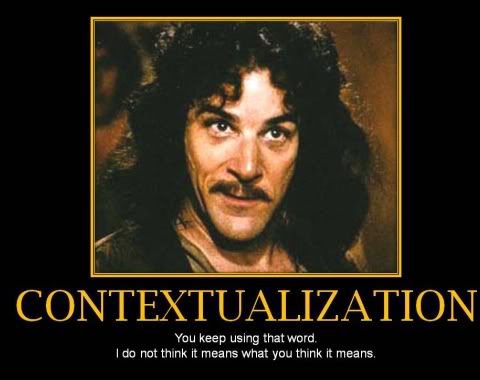
Unfortunately stakeholder involvement is often  misinterpreted.  We THINK we are doing something, but what we are ACTUALLY doing is

Meme Image originally from The Princess Bride


Here is what I think of when I see STAKEHOLDERS in a collaborative process.

I see a group of people, without hats of power, coming to consensus.
We don't always agree, but we agree not to sabotage.
We educate one another, and we allow anyone who wishes to attend.


created with Open Office


This opportunity is what education  is about.  We learn and grow together.  The leader empowers the others.


But that opportunity is rare outside of #edcamps.  
It assumes that all people are treated with equal respect, and insight comes from many quarters. 
 Expertise is balanced by new ideas.

##
The antithesis of this is much more common.
Marginally empowered in the decision making.
It becomes, as I realized in a dyslexic moment, about
SKATE HOLDERS

In this scenario, the people chosen are hand-picked.
Outliers are usually ignored.
The input is gathered, but the information is given in parcels. 
Doled out like medicine.
One or two people can say no, as they are the stars of the show.
Like the forward on a hockey team.
Everyone is protecting them.

The others at the table get to hold the skate guards.
Ideas that don't match are at best deflected gently.

The uninvolved usually have a decision placed upon them.
They are simply the hooks to hang the skates upon.

created with Open Office

Eeeeeeeeeeek!  
We've ALL been part of this.
Lecture-based classrooms.
Traditional professional development.
Innovation-of-the-week.
Church board.
Nontransparent government.


BECAUSE UNLESS

You move to collaborative leadership.
Put the permissive 'buck stops here' back on the shelf.
Shrink your ego.


And start the process of decoding the dyslexia.

BECAUSE

Real learning starts when the skate holders
Stop being the crowd.
Lace on their own footwear.
And start moving
Dancing.
And becoming part of the team.


skate holder--> stakeholder
#transformation


Monday, November 11, 2013

Disconnect: Is It Possible?


The video above and this blog post really made me stop and think.  And when I do, I often find myself asking students what they think.  So I asked 43 of them, using a short Google form.


The results were really pretty clear.


Most of my kids have handheld devices.   No surprise there.  The worry, however, is that these three kids will be shut out of the collaboration. What can we do about this?


Note that more than half of the kids are always connected.  Are you?
Our society seems to have a pretty high tolerance for digital devices being out.  Personally, I prefer them to be off during meals.  What about you?


Panic from a device disconnect..  Does it affect you and your classroom?


Other than one person who told me clearly to push off, I see some honest admission of addiction here.  What implications does that have for our classroom?


Monday, October 21, 2013

Knowledge, not Grades

It's the end of the quarter, which means it's time for my recurring theme of knowledge > grades. 

photo credit: Ken Whytock via photopin cc
I do not like grades, or points, or spam. 
I do not like them, Stan or Pam. 
I'll tell you what you've done for me, 
But is that an A, a B, or C?

Depends if it has changed your learning.
Or if your brain is still a-churning.
If it was garbage in, then garbage out.
Than all I can do is cry and shout.

For learning takes a skill that's new.
And shares a passion that is true.
It's more than simply jumping hoops.
It changes minds, it's like a soup.
That gets much richer as it stews.
A process to enrich, renew.

I do not like the grades or spam.

It will not tell you who I am.

Thursday, October 10, 2013

Find the Big Question. Answer with Relevancy and Tech Integration

It's the end of our velocity and acceleration unit.  We've used formulas, graphs, models, motion detectors and diagrams to help us with our problem solving skills.  Now, it is time to apply.  The big question for this unit:  "How well is life mimicked in video or cartoons?  Use your kinematics knowledge for analysis of three situations.

Not all kids approached this the same way.  Some kids compared an actual video to a cartoon.  Others compared old-style animation to computer animation.  Still others made stop motion movies.   I required them to take screen shots of their evidence and blog their answers. To do the comparison, they needed to use a video converter and/or upload their videos for analysis with Vernier Logger Pro.  Then they write a final reflection, which I look through to find claim, evidence, and reasoning.

Blog 1:   http://mitchphysicswd.blogspot.com/

Blog 2:  http://lulustoll.blogspot.com/

Blog 3:  http://stephenlegomotion.blogspot.com/

Blog 4:  http://jakevoss.blogspot.com/

Blog 5:  http://reeannnicolehannahnathanphysics.blogspot.com/

Blog 6:  http://brookesadiesarah.blogspot.com/

Blog 7:  http://kaylarrecker.blogspot.com/

Blog 8:  http://karamoorman.blogspot.com/


photo credit: Ryan Bretag via photopin cc

Conclusions


1.  This is higher order thinking.  Thank you, Google Apps, for giving me a suite of tools like Drive, Blogger, and You Tube.  I'm sure things could be done in other ways, but this is the set of apps my kids work with.  Note that they are TOOLS, not the project itself.  That's the point of tech integration.


2.  Access to real data is cheap and easy. Thank you, Vernier, for the Logger Pro software, which has a building -wide license for $250.  I purchased it about 11 years ago, and have used it with more than 1000 students. Each kid in school can download it for use on their own machine.  That's about a quarter for an incredible data analysis machine.


3. STEMx and tech integration.  My students learn about codecs, conversion, scaling, and media formats, and they get to analyze motion and report results. This is real work, solving real problems.  It's the basis of STEMx.  How cool is that?!

3.  Individualization.  Some kids videotaped the screens of their computers, and imported that file to the computer.  Others used a screencast tool.  Still others downloaded the youtube file, and then converted a .flv to .avi or .mov file. I had stop motion movies created with Windows Movie Maker AND with smartphone apps. This ability to manipulate digital data is part of the culture of empowerment I try to create in my classroom.

4. Summative assessment.  Through the reflection on the blog, the data analysis, and the individual reflection and one-on-one discussions I have with each student during this process, I can tell how well students understand the derivative of a d-t graph, the meaning of velocity vs. acceleration, and the patterns that are recognizable in the physics we are studying. I have a rubric that lets me see where they are at. In short, this assessment is rooted in the Cross-Cutting Standards of the National Science Framework.  It's meaningful and worthy of the world, or they don't get it.  But I know, in the conversations, if they get it.

5. Real world transformation.   There is no ONE way to do this...it is student-centered.  There is just a task, and a process. Problem-solving is evidenced.  Trust in my students' abilities is a critical process.

Think differently.  Transform your teaching.  Engage kids. Treat them as capable. Help your students solve big questions.  That is what kids need for the future.


4.

Monday, September 9, 2013

Integrity and Failure

photo credit: Cinzia A. Rizzo / fataetoile via photopin cc


Today I tried to do something in my life.  I tried my very best.

And I failed spectacularly. It was awful.

The circumstances don't matter.  The feelings do.

I stood there, with tears running down my face and mucus filling my throat and not enough tissue to blow my nose.  And the internal embarrassment was real as a colleague dressed me down.    .


It would have been easier not to try at all.  Failure would have been avoided.  But that would not have been honest.  And there is integrity in that.

Later I received a message from a dear person in my life, struggling with an issue of whether or not to drop a class during her senior year in college since she has never ever quit at something.  And I knew exactly how she felt.  And there was this amazing comment from one of her friends (who gave me permission):

"Relax. Breathe. Dropping a class is not the end of the world. Heck, failing a class isn't the end of the world. This class may not be the right thing for you this semester with everything else you've got on your plate. Professors understand that students are people. It's not the end of the world. You can do this. You have so many talents, don't worry about disappointing anyone."


Someone else had a day just like me.  And it was good advice.

So I learned something in the process.  First of all, I had a moment of remembering what it was like to be a child, a student, or an athlete who was totally lost and struggling with an issue.  I wanted to run away.  For just a moment, I was that most miserable kid in my room who had just definitively failed at something.

Failure stinks, but the attempt may still be honorable.

Now what?  What's the lesson for me as an educator?  
.

Simple.  I learned the value of a supportive adult all over again.  Haim Ginott was right.


Tuesday, September 3, 2013

Is ALICE a #gamification of school safety?

I've been searching for something that has bothered me for the last two weeks.  And that's ALICE training for school safety, which has become a training option for many Iowa schools.  I first heard of ALICE when my husband came home from a school safety conference, and was very positive about it.  Some individuals I've talked to said it's empowering as adults because it gives them options for control.  As a hunter, I am not anti-gun, but I don't know if I want to go through this simulation, even if it is voluntary.  The very thought triggers anxiety in the pit of my stomach.


It doesn't take much to find stories on trainings that support the PRO viewpoint.  NPR, the Gazette, Cinncinnati, and the University of Iowa all have ready links with a quick search

It's not that I oppose training for emergencies.  Really.  We have fire drills, tornado drills, bus evacuation drills, bomb evacuation drills and schedules for everything from lunch duty to pep bus sponsors.  I like the idea of some of what ALICE is advocating.

  • Alert Everyone
  • Lockdown Your Room
  • Inform People in the Building
  • Counter by Attacking the Intruder<--this is some of what I have trouble with
  • Escape if Possible
ALICE even makes that claim that is it DHS-approved on some of the sites I found.  So I looked it up. And I found that indeed, the Department of Homeland Security does publish an a document on dealing with many of the things listed above.  In its pamphlet an Active Shooter in a Building  it says, as a very last resort, throw something at the intruder.

It also says:

Components of Training Exercises 
The most effective way to train your staff to respond to an active shooter situation is to 
conduct mock active shooter training exercises. Local law enforcement is an excellent 
resource in designing training exercises. 
• Recognizing the sound of gunshots  
• Reacting quickly when gunshots are heard and/or when a shooting is witnessed:
- Evacuating the area
- Hiding out 
- Acting against the shooter as a last resort
• Calling 911
• Reacting when law enforcement arrives
• Adopting the survival mind set during times of crisis

Perhaps my problem is how the training is conducted.  In all the videos I have searched on you tube, I see people running through a school building shooting guns and pretending to be intruders while others are present.  Talking to other educators around the state has led me to believe that intruders in these Iowa trianings are also equipped with pellet guns to fire at participants.

To me, it's surreal.  It's #gamification, like a round of Halo or a game of paintball, rather than a real life-or-death situation.  I was taught that guns were not used in the manner below.


Here's my point.

I support fire drills---but I've never had a flamethrower wielded at me as I walked out of the building.

I support tornado drills--but I've never had someone throw broken glass at me to simulate a twister.

I support fire arms training--and Iowa has an excellent Hunter Safety program.  But why would you subject individuals to an exercise like this in ways that could trigger anxiety attacks, PTSD, asthma attacks, or, worst of all, a superiority complex that leads them to believe it is all just a game?  We already know that teens and children react differently than adults on decision-making, and yet we are perhaps putting them in the cross-hairs of a dangerous make-believe.

Perhaps I am overreacting.  

  • As a parent, I know schools have a responsibility to protect kids/
  • As a teacher, I am wary of liability.  I also don't want simulations that are quite this realistic. 
  • As an administrator, I'm sure there are staff members who won't participate, so there must be reasonable alternatives.  
  • And as a board member, I'd think that we would want to have research for the liability and policy considerations that this type of program simulation entails.


Anyone have a better solution for a terrible problem?


RESOURCES
I'm still searching for the research out there that tells me how this has been effectively used in schools or other places to thwart intruders, and perhaps that research is out there.  But it didn't seem to work at Ft. Hood when you had trained service people.  It didn't seem to work when instructions similar to ALICE http://en.wikipedia.org/wiki/2012_Aurora_shooting#Shooting  Here's what I have found:

Against:
http://commonhealth.wbur.org/2012/12/psychiatrist-alice-children
http://www.schoolsecurityblog.com/2013/03/psychologist-alice-training-is-an-overreaction-and-potentially-dangerous/
http://t.co/16fuQxwNmo (Parents have a responsibility to ask about what their kids should do) via @Paul_Mugan

Neutral
http://www.dhs.gov/school-safety

If you have a link to contribute that designates safety information that you think might be helpful, please let me know.  I would love to see the board policies and ideas that are behind such weighty decisions.


Goodwill Drive


West Delaware Students and Parents:

KFXA FOX-28 is hosting the 1st Annual Goodwill Drive to Victory” during the football season across Eastern Iowa.  Included in their Drive to Victory is this week’s game between West Delaware and Dyersville Beckman.  Both schools have one week to donate as much as possible to the Goodwill trailer located at their school.  The winning school will be announced Friday during the game at Dyersville Beckman. 

A Goodwill drop off station is located in the West Delaware High School Parking Lot.  Clothes and household items can be dropped off this week only.  Please help us collect as much as possible this week.

So, clean out your garage, your closet and basement.  Look for those items that you no longer use which may still be of value to someone else.  Clothes, toys and household items are accepted.  No food please. Drop off your donations at the Goodwill trailer in the West Delaware High School Parking Lot.  Tax Deduction Forms are located inside the trailer.  

If you have any questions, contact Mike Morrison at 927-3515 ext. 302.


Friday, August 23, 2013

I Liked It So Much I Bought Two....

Stop reading this post.  Stop right now.  Click on this link and buy yourself a copy ofTeacherpreneurs: Innovative Teachers Who Lead But Don’t Leave.  Come back when you're done.  The post will be right here waiting for you…
Cool!  Welcome back! 
If you are a teacher who wants to effect positive change in your school, district, or state; if you don’t want to leave your classroom and your kids to do this; if you’ve often thought, “There has to be a way to do both,” then this book might be the best thing you read this year. 
Clearly, I love this book, so let me tell you why I bought two copies.  First, I was impatient.  When I first heard about this book, I got so excited, that I pre-ordered a copy.  Then, I found out that the Kindle version was available several weeks before the hard copy would be released, so I bought that one and devoured it in only a few days, thinking about colleagues of mine who need to read this book.  When my pre-ordered copy arrived, I thought, “Sweet!  Loaner copy!”
I wish there had been a concept like “teacherpreneur” fifteen years ago as I was starting my career. 
I’ve been doing teacher leadership for over a decade: 
  • Training student-teachers from the local university; 
  • Heading our accreditation process or strategic planning;
  • Serving as a union leader; and
  • Influencing policy makers to pass school-reform legislation that would be good for kids.  
In every one of those incarnations of teacher-leadership, I have always been a full-time teacher, working 10-11 hour days.  I would engage in the leadership half of my role in the evenings and on weekends.  Equally exhausted and exhilarated, I would often wonder if there might not be a better way.  In Teacherpreneurs, the authors show us that teachers can be site, district, state, and even national leaders while keeping a foot firmly grounded in their classrooms and keeping their sanity. 
Perhaps the section I found most powerful were the chapters detailing the stories of several of the Center for Teaching Quality's teacherpreneurs.  Barnett and his team pull no punches and forgo any sugar coating.  They share frankly the successes, challenges, lessons, and barriers they’ve encountered over the past three years as they’ve designed and implemented this new classification of educator. 
The core idea of the book is one that the folks at the Center for Teaching Quality unveiled in their first book, Teaching 2030.  “Teacherpreneurs” are teacher leaders who have hybrid positions.  They work one full-time job, but within that one job, they are in front of a classroom full of students part time, then doing the leadership (or “-preneur”) aspect of their job part time. 
A teacherpreneur might include a high-school teacher who teaches in the morning, then writes, organizes, and delivers the districts professional development in the afternoons.  She might also be a middle-school teacher who teaches classes at the local university, training the next generation of teachers, before arriving at her school to teach 7th graders in the afternoon.  He might also be an elementary school teacher who hands his class over to his partner-teacher on Wednesdays, so he can spend the rest of the week at the state capitol, advising law-makers on educational policy.
If one of these teacherpreneurs sounds like you, or if hearing about these possibilities, you imagine your dream teacher-leader role, then this book is for you.  When you read, if you are seriously interested in creating your dream role, don’t skip over the exercise and discussion sections that complete each chapter.  These sections can help you plan your way to your dream role. 
Shameless plug: There are discussion communities on CTQ’s Collaboratory and on Facebookthat are engaging in activities connected to the content at the end of each chapter.
Additionally, read the appendix.  Barnett and the team thoughtfully include examples of a teacherpreneur job description, a memorandum of understanding between a school district and an outside organization about how the two would share a teacherpreneur, and other valuable resources.
Teacher leaders, buy this book.   Heck, buy two like I did and have a loaner!  We shouldn’t have to choose between our classrooms and kids and the opportunities to share our expertise with our schools, districts, and states.  It’s time for a smarter, more sustainable concept of teacher leadership.  It’s time for teacherpreneurs.  
==============

For more great conversations and learning like this, check out the Center for Teaching Quality collaboratory.

Thursday, August 15, 2013

The Bionic Student

Today was the first school day for my classes.  I teach a mix of 9-12 high school students, with one 9th grade class, and most of the others being upperclassmen.

We don't have a 1:1 initiative at my school, but four years ago, I swapped out books for a series of 16 laptops.  That's a great thing for partners, and I use them frequently, but my go-to tool today was a combination of that and the student smartphones and/or e-readers.  Kids can use whatever tool they feel comfortable with; a few kids grabbed laptops, but since more than 80% of the upperclassmen had smartphones, a lot of them just used those.  It's comfortable.  Some text, some talk, some use Swype.  It works for them.

photo credit: William Hook via photopin cc


Back in your brain, you might remember a TV show called The Six Million Dollar Man.    It was about a cyborg, also called a bionic man.   The show, while cheesy, has the tagline that fits this transition into technology.  Can you remember it?  Look further to see why it matters.


So what did we do in today's shortened classes?
  1. Downloaded the Google Drive app to most phones.
  2. Created documents on Google Drive via app or laptop.  Shared those documents with the teacher account.
  3. Downloaded free planetarium software to the App page of Google Chrome (laptops) or smartphones.
  4. Took pictures of information on the board.
  5. Created a reminder of physics supplies needed for tomorrow's labs.
What will we do tomorrow?
  • Tweet our Claim/Evidence/Reason regarding a physics lab.
  • Receive instruction at a personalized pace from a class blog
  • Look at different views of the sky from varying latitudes.
  • Reflect in the shared documents we created yesterday (personal journaling and metacognition)
  • Share real-time data.
  • Fill out a getting-to-know-you form.
  • Write a 140 character summary.
  • Take a formative assessment.
  • Access a flexbook.
That tagline, mentioned above:

"Steve Austin, astronaut. A man barely alive. Gentlemen, we can rebuild him. We have the technology. We have the capability to build the world's first bionic man. Steve Austin will be that man. Better than he was before. Better, stronger, faster."
-Oscar Goldman


Sure, there will be days that we use only laptops, when we need to run a java simulation, but they are few and far between.   Because technology is no longer a nice add-on. It's a fundamental way of doing work that is worthy of the world.  That's why I've changed the tagline:

"OUR STUDENTS are the next dreamers and astronauts. Some come to school and feel they are barely alive. We can rebuild schools for her or him. We have the technology. We have the capability to build the world's best schools.  Better than they were before. Better, stronger, faster to acknowledge that students and their way of doing things matters."
-(apologies to) Oscar Goldman


THAT is what I want for my students, and that is the freedom I NEED from my administration and education as a whole.


Thursday, August 8, 2013

A Broken Cog--Teacherpreneur Version

Today was a disappointing day.
I had floated a proposal earlier this summer regarding a solution that I felt was a win-win for a changing world.

  • It was based on instructional coaching and content research.  
  • I had worked with others in conversations.
  • It was grounded in pedagogy.
  • It was more economical than corporate solutions.
I thought it was sound.  So did others.  I poured my heart and soul into this vision, as I do into everything that I believe matters.

It was flushed at the last minute after months of work. And I was frustrated.

This is also a stage in being a teacherpreneur.  Because sometimes the chips don't fall your way when you speak up.

Sometimes, teachers are not recognized as an equal partner because they stayed in the classroom.  Teachers may have as much or more education as the other entity involved.  Perhaps they have more pedagogical expertise.  And yet, our educational system is just beginning to come out of a 'parent-knows-best' CEO model and move to collaboration leadership.

As we shift our ecosystem to 21st century thinkers, school boards, administrations, and teachers will have to become equal partners, and will need to make their case to a community of parents, students, and business owners.  That becomes transformation, and a shared vision.

photo credit: GuySie via photopin cc


It's only when we work together as a team that great things happen.   This was a reminder of a singular truth.

One cog, no matter how big, cannot make the entire system work together, but one cog that jams can bring the entire model to a halt.  

Not all my ventures are successful.  And that means that my personality has to be strong enough to deal with the reality of disappointments.  And tomorrow, after a night to revamp, I will try again, moving to a new opportunity.  Because that's what I do.  I believe in education and have the passion needed to help transform it.  That is my story, but it is also the story of teacherpreneurs across the country.


Wednesday, July 31, 2013

What are the Drivers of a School Start Date?

I read Trace Pickering's arguments about Iowa start dates, and highly recommend it.  Local control really does go a long way in making the correct choices for a community.

But as we go through this discussion locally, let's take a minute to think about why we have a summer break in the first place.  Three seconds to get your answer.

WHY SCHEDULE OUR BREAKS AS WE DO?


3

2

1

Did you answer agriculture?
I'll bet that's a common answer.  I have heard it at countless in-services.  But if you have a local community school, and you don't have an ag system, why do you still start after August 1?

Because it is the wrong assumption and it has been made a scapegoat.  Agriculture involves less than 3% of the population. Pesticides and big round bales have replaced much of the manual work that used to be done with teen labor.

=========================================

Consider the other drivers when you have this discussion:


  • Weather.  School buildings are designed with relatively low insulation value, which is not helpful for AC.  There's a reason for that--crowd 150 kids into a building day after day and there's a residual heat buildup.  Any teacher can tell you Monday morning temperatures in a building are less than Friday morning.
  • Youth Activities.   IHSAA and IHSGAU set the practice dates for fall sports, and they have moved up, as have school calendars.  However, we have club sports, college camps, and the Iowa Games. County fairs,wim team, little league, summer town celebrations, summer camps also play a part in the vision. Summer is the logical time for many of these and a great example of long-tail learning. 
  • Vacations.  This is a driver, but less than one would think.   One good argument for an early start date is actually the fact that families pull kids out of school for vacation whether school is in session or not.  Family time trumps school time in the eyes of most stakeholders.
  • Higher Learning.  Want highly educated educators?  Set your school schedule around the times when the classes are available. Most advanced degrees still have an on-campus requirement for part of the process.  Have Iowa colleges and universities weighed in on this?  If we are honest, schools should be streamlined to work with them in an era of concurrent-enrollment/senior year plus.
  • Facilities Management.  Visit a school during the summer and see how things are moved around, disrupted.   I am sure much of this could be scheduled during breaks, but this work is a source of income for young people as well.   Maintenance staff paradigm shifts take education and careful scheduling.
  • Lack of Stakeholder Involvement. Many administrative teams make the calendar and give it to the board.  Sometimes they give the teachers a choice of one or two calendars in advance.  But there is almost no parent, community, or student stakeholder involvement.  Why do we make decisions for kids that involve large chunks of their life in a authority-knows-best manner?   How about an open meeting to ask for that input and leadership?


Kids can learn whenever we give them the chance. It's a local decision.  But it is also a statement of what your community values.  Think about it.


Thursday, July 25, 2013

The Internet Misinformation Virus

photo credit: TedRheingold via photopin cc

This headline made me laugh.  But is also gave me pause.  Because it is easy enough to see the fear virus in education.


 It's easily transmitted through the Internet of Misinformation.


I have spent this summer looking at a topic that is a vocal view of very conservative people.  It is based in a belief that the Common Core is a Social Evil and you are the unintentional victim of mind control. Don't believe it? Check these articles designed to quash the Common Core.  Why? Because it is, in their eyes, an affront to their freedom, federal control of education, buying education by the Gates Foundation, an attack on their religionspreading Marxism, and data mining akin to the mark of the beast. They are passionate about what they believe, which is one of the reasons they fought hard for homeschooling in Iowa in the last year.

I believe in freedom of speech, and I have had some lively discussions, but I don't agree.

That is why I appreciated seeing Conservatives for the Common Core  (@CFHStandards) come out with a website to in support of the initiative, using the names of @TerryBranstad and Mike Huckabee as supporters.  If nothing else, take a look at the Myth vs. Fact section.

Because all of us will encounter this at some point.  And if we believe in our curriculum, and Iowa Education, we should be educated enough to be able to answer.